Every gamer has been there: you pull off the clutch 1v5, the impossible no-scope, the last-second save that turns a whole match around — and then it's gone. Buried somewhere in forty gigabytes of raw footage, or worse, never recorded at all because you forgot to hit the button. Clipping, streaming, sharing, and actually building a community around your gameplay usually means juggling five different tools that were never designed to talk to each other: a recording app, a separate streaming client, a video editor, an upload workflow for every platform you want to reach, and a social feed that has nothing to do with games at all. Every hand-off between those tools is a moment your best play quietly dies in a folder nobody opens again.
Cliggs exists to collapse all of that into one loop: play, stream, clip, share, compete. No more choosing between platforms, no more forgetting to hit record, no more losing an hour to hunting for the ten seconds that actually mattered. This post walks through exactly how that works in practice — from the moment you create an account to the moment your best play is sitting in front of a community that actually cares about it — and by the end, it should be obvious why that loop is worth switching to if you're currently stitching it together yourself.
1. 🔑 Signing Up and Logging In
The first five minutes with any platform set the tone for everything after, so Cliggs keeps this part deliberately frictionless.
🔐 Multiple ways in, one identity out
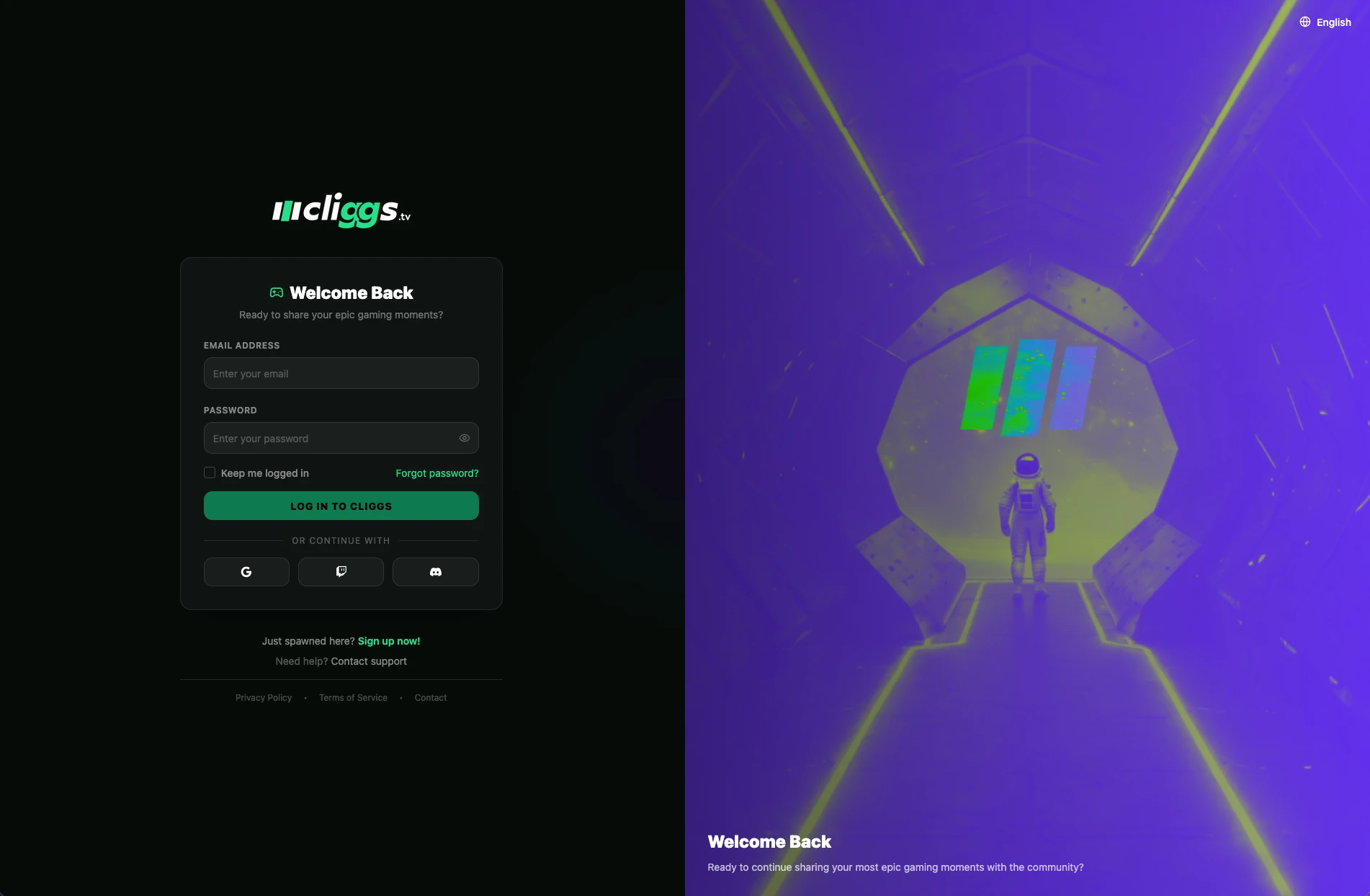
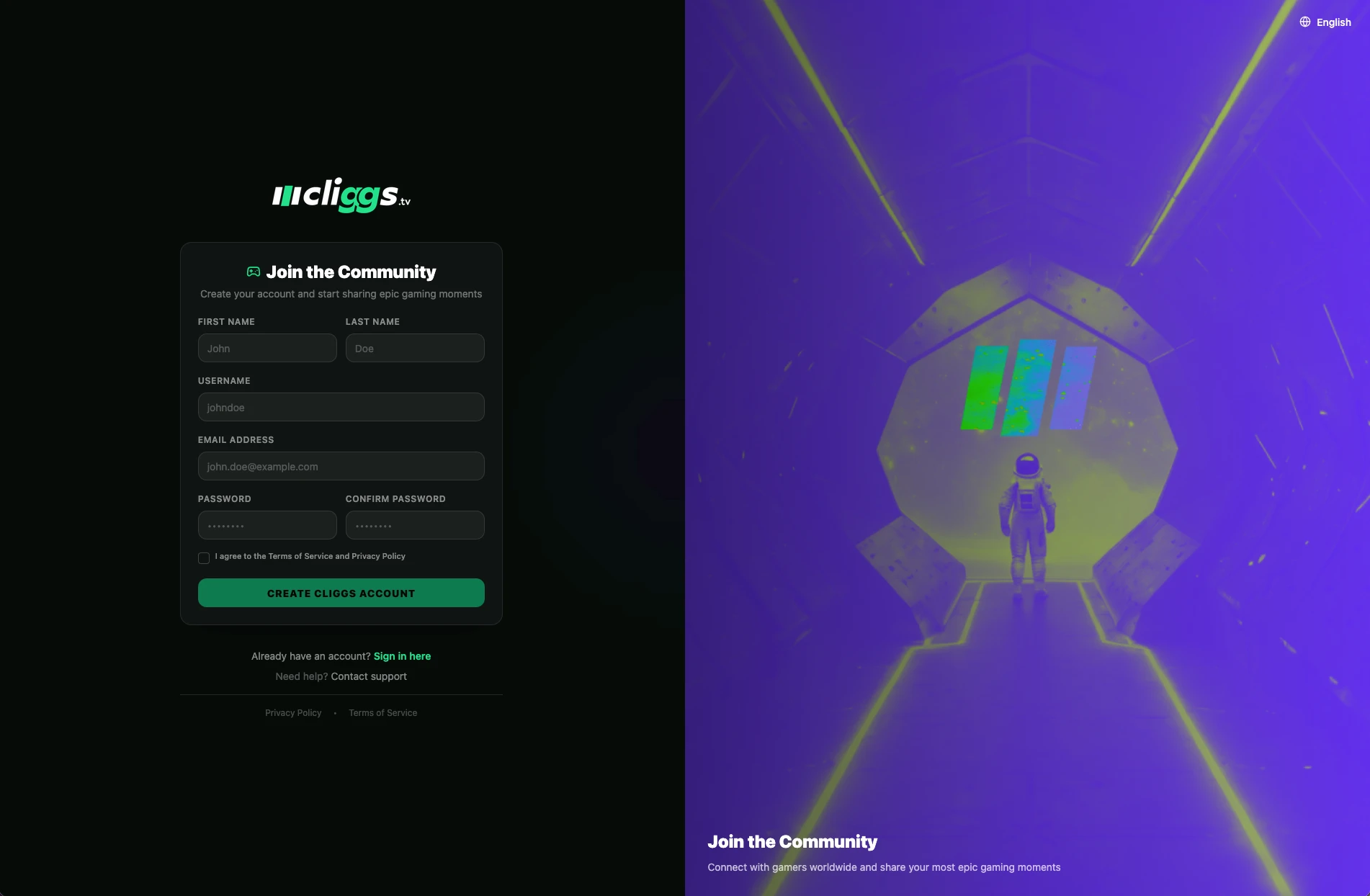
You can create an account the traditional way, with an email address and password, complete with email verification so your account stays secure from the start. But most people don't want to remember another password, so Cliggs also supports single sign-on through the accounts you already use every day: Google, Discord, Facebook, Apple, Twitch, and TikTok. Sign in with whichever one is fastest for you, and you're in.
This matters more than it sounds like on paper. Gaming identity is scattered by default — your Discord is where your friend groups live, your Twitch is where you stream, your TikTok is where short clips travel fastest. Rather than forcing you to pick one as "the" account, Cliggs lets you link multiple social accounts to a single profile. Your Cliggs identity becomes the hub, and the platforms you already use become spokes connecting into it, instead of five disconnected islands of the same person.
🔁 Lost password? No dead ends
If you forget your password, the recovery flow is built to actually get you back in rather than leaving you stuck: request a reset, get a recovery code, set a new password. No support ticket required for something that routine.
🎟️ Invite codes and getting help
Cliggs supports invite codes at signup — if a friend or a creator you follow sends you one, you can redeem it as part of account creation, which is a small but deliberate nod to the fact that gaming communities grow through word of mouth, not cold acquisition funnels. And if something does go wrong, there's a built-in support ticket form so you're never stuck emailing into a void.
👤 What you get once you're in
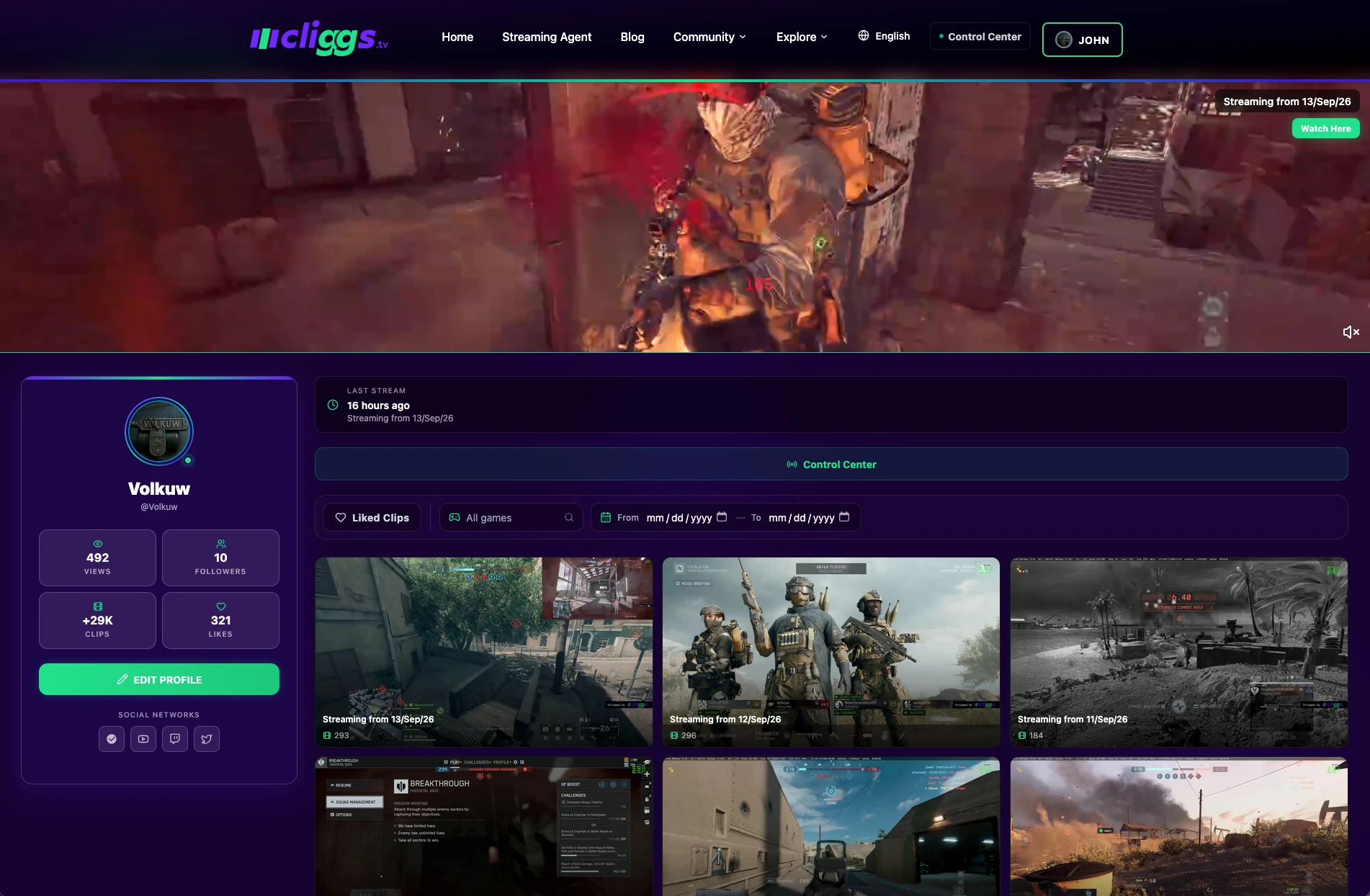
Once your account exists, you land on a real profile — not just a username and an avatar, but a page that represents your presence on the platform: your clips, your follower and following counts, and (if you choose to connect them) your actual in-game stats from supported titles like Battlefield 6. You can edit that profile at any time, connect your social links, and start building it out before you've even uploaded your first clip.
Everything you need to manage that presence is one click away, too — click your username anywhere on the site and you get a quick menu with My Profile (jump straight to your gaming stats and public page), Settings (customize your experience without hunting through menus), and Logout when you're done for the session. Nothing about managing your account should take more effort than the account itself is worth.
⚙️ Gaming Settings: your whole account, one screen
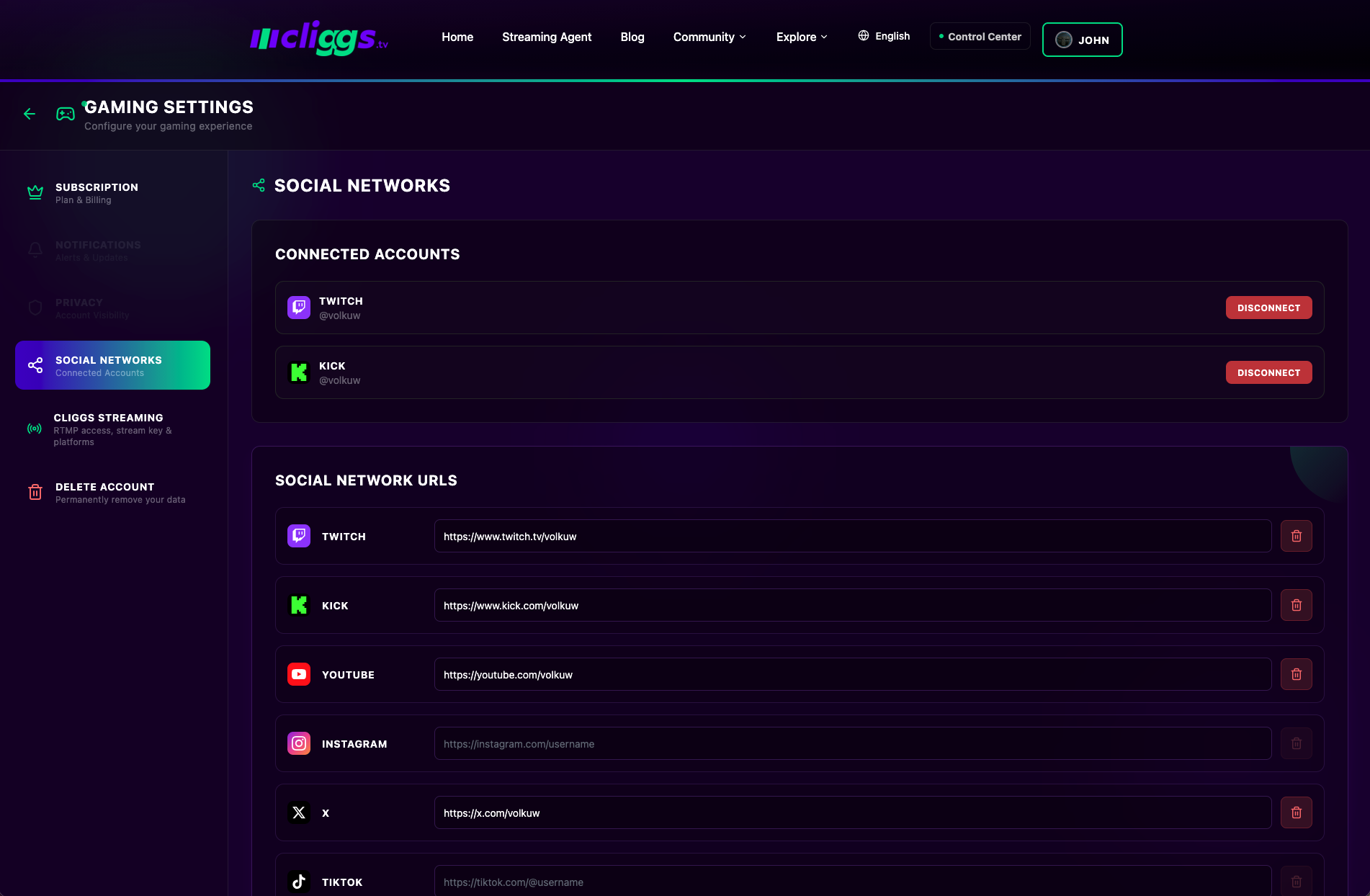
Settings is where the account-management side of Cliggs lives, organized into a simple sidebar rather than scattered across menus:
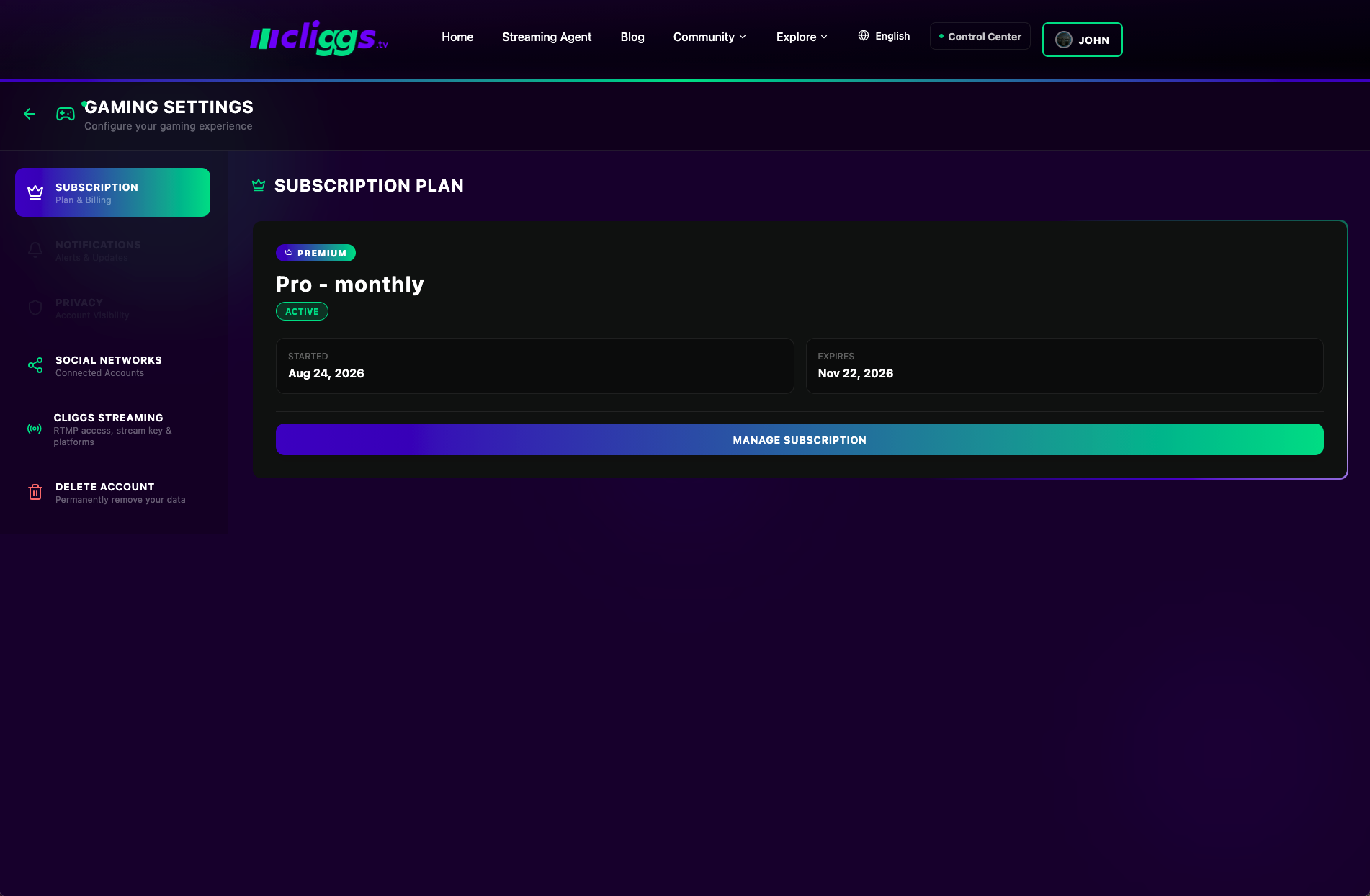
- Subscription shows your current plan (Free or Pro) front and center, including its status, start date, and renewal date, with a one-click path to manage or change it.
- Social Networks lets you connect and disconnect accounts like Twitch and Kick directly, and separately lets you attach public profile URLs — Twitch, Kick, YouTube, Instagram, X, TikTok — so your Cliggs profile links out to everywhere else you post.
- Delete Account is there too, front and center rather than buried three menus deep, with a clear, honest warning that it's permanent. Cliggs doesn't make it hard to leave — it just wants you to know exactly what you're choosing.
(Cliggs Streaming — the RTMP setup for connecting OBS directly — lives in this same Settings sidebar too. More on that in a minute.)
The whole point of this stage is that it should take less time to read this section than it does to actually do it. Sign-up is not where Cliggs wants your attention — gameplay is. So it gets out of your way fast.
2. 🎥 Setting Up OBS and Going Live
This is where Cliggs stops being "just another upload site" and starts being infrastructure for how you actually play and stream.
🔌 The companion app bridges your existing setup
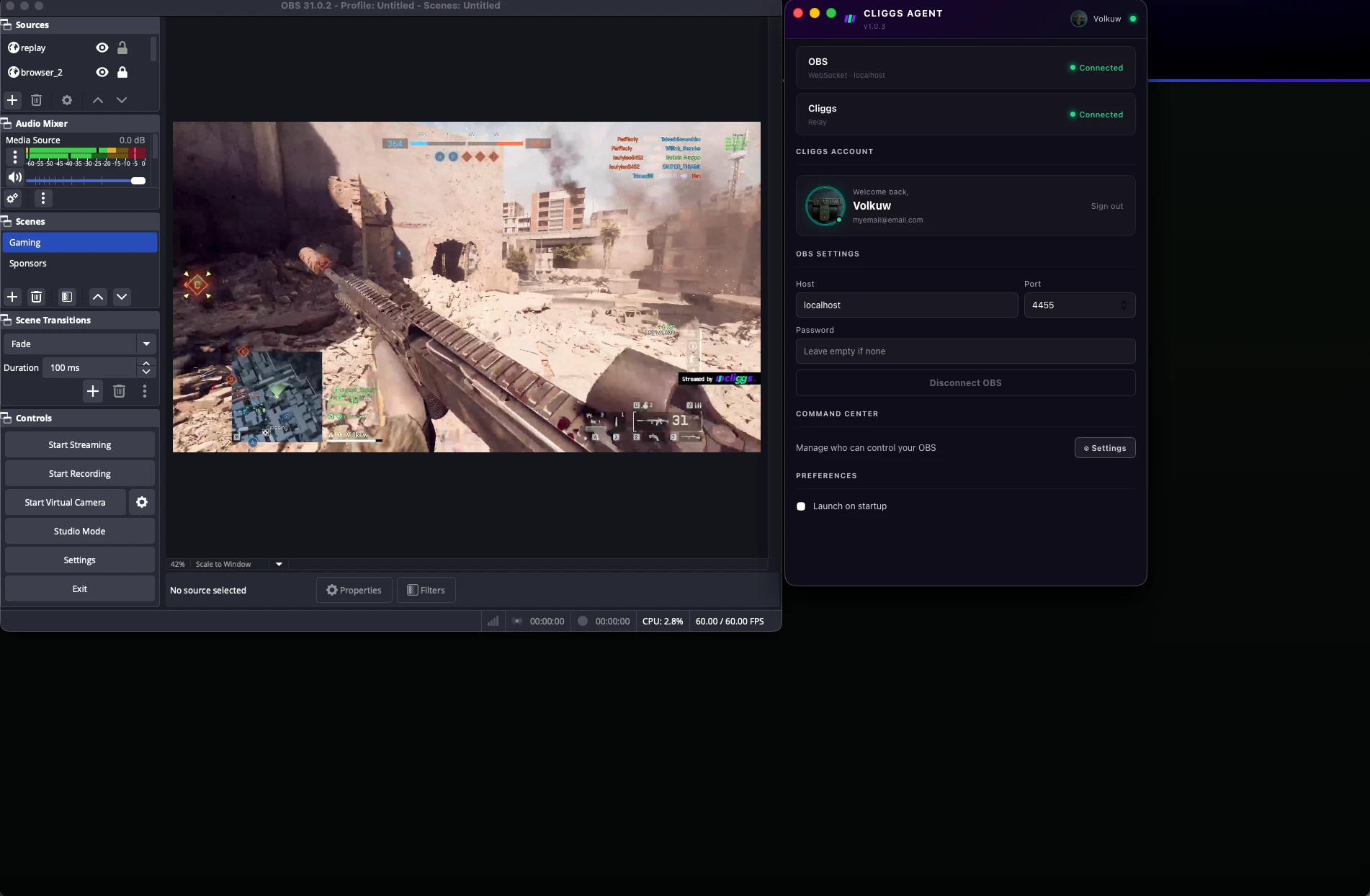
If you already stream with OBS, you don't have to abandon that workflow to use Cliggs. Instead, you install the Cliggs desktop companion app — a lightweight bridge that connects to OBS over its WebSocket interface and talks to Cliggs' streaming relay in the background. You keep your scenes, your overlays, your hotkeys, your audio setup — everything you've already tuned — and Cliggs plugs into it rather than replacing it.
Getting connected is a short, linear process, all inside the Cliggs Agent app itself:
- Download and open Cliggs Agent (available for macOS and Windows). It shows two connection statuses right up top: your local OBS WebSocket link, and the Cliggs relay itself — both start out "Disconnected."
- Sign in with your Cliggs account — email and password, right inside the app.
- Enter your OBS WebSocket details under OBS Settings: host (
localhostby default, since OBS is running on the same machine), port (4455by default), and a password if you've set one on OBS's WebSocket server — then hit Connect OBS. - Once connected, the Cliggs relay flips to Connected, your account shows as signed in, and you're linked up end to end.
From your side, streaming still feels like streaming. The difference is everything that happens next.
📡 One stream, every platform, at once
Once you're live, Cliggs relays your broadcast out to Twitch, YouTube, and Facebook simultaneously. This is the multistreaming piece, and it solves a problem every streamer eventually runs into: audiences fragment across platforms, but your attention and energy don't multiply to match. Historically, "being on all three" meant running multiple encoders, eating extra CPU and bandwidth, and hoping your internet connection could take the hit. With Cliggs handling the relay, you stream once from OBS, and the distribution to multiple platforms happens on Cliggs' infrastructure, not your gaming PC.
Practically, this means:
- Your Twitch regulars, YouTube subscribers, and Facebook followers can all watch the same live session without you doing anything differently.
- You're not forced to choose a "primary" platform and treat the others as an afterthought.
- Your local machine keeps its resources for the thing that actually matters — the game itself.
🛡️ Command Center: who else can touch your OBS
Once you're signed in, a Command Center section appears in the Agent, right below your OBS connection settings — and it's worth not confusing this with Control Center (the live dashboard, covered next). Command Center is about access and destinations:
- Command Center Users: a whitelist of exactly who's allowed to send commands to your OBS through Control Center. Search a username, add them, remove them whenever you want — nobody else gets control by default.
- Streaming Targets: your connected destinations — Kick, Twitch, YouTube, and more — each with its own stream key (masked, with a reveal toggle), an active/inactive status, and a delete option. There's a cap on how many targets you can run at once, shown right in the panel (e.g. "3/3 limit reached").
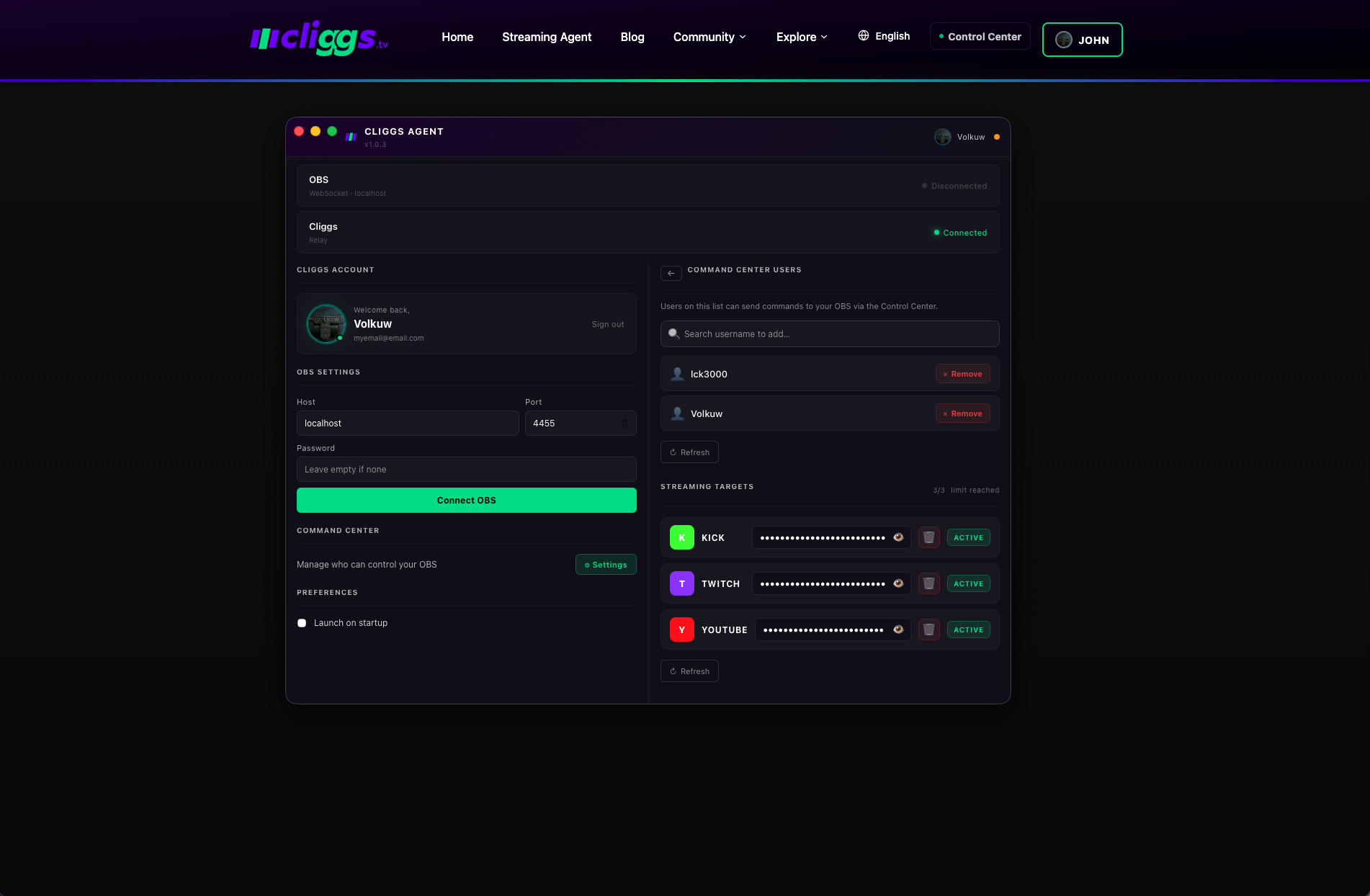
Think of Command Center as the settings that decide who can touch your stream and where it goes out to. Control Center, below, is the live surface you actually use while streaming.
🕹️ Control Center: your entire stream, one dashboard
Once Cliggs Agent shows both OBS and the Cliggs relay as Connected, the Control Center page comes alive. Open it while the agent is checking in and you'll briefly see "Checking agent status..." — then it snaps into a fully loaded control surface, with your broadcast destinations (Twitch, YouTube, Kick) listed right at the top next to an End broadcast button.
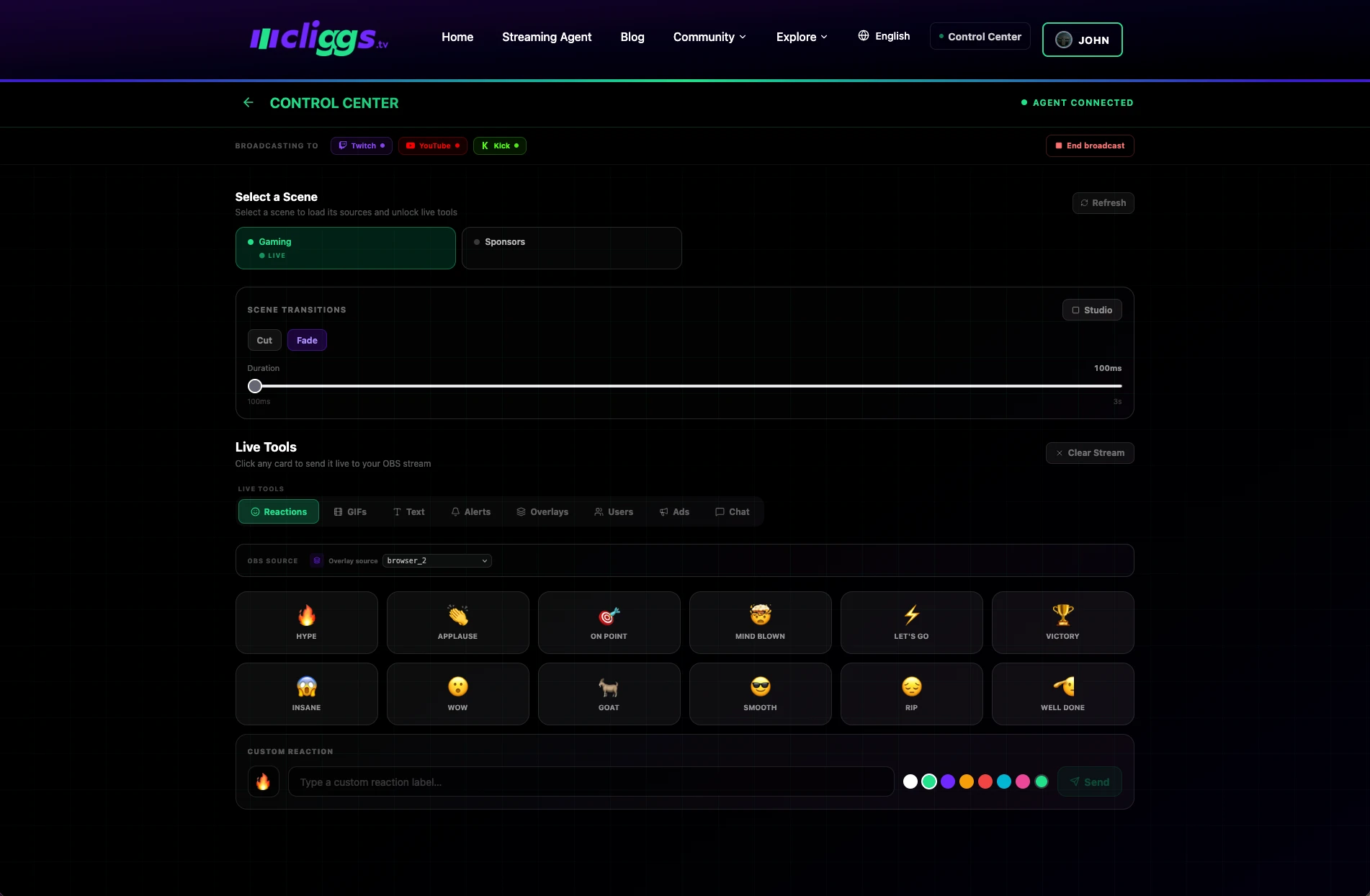
From there, everything you'd normally handle inside OBS itself, or in some separate alert tool, lives in one place:
- Select a Scene. Every scene from your OBS setup — Gaming, Sponsors, whatever you've built — shows up as a clickable card, with a LIVE tag on whichever one is currently on air. Click another one (say, switching from Gaming to a Sponsors scene) and it goes live immediately, transition and all.
- Control your Scene Transitions. Pick Cut or Fade and dial in the exact duration with a slider — the same control you'd normally dig through OBS's own settings menu to find.
- Fire Live Tools straight into your stream. A row of tabs — Reactions, GIFs, Text, Alerts, Overlays, Users, Ads, Chat — puts everything at your fingertips, and every one of them lands in OBS instantly, as a browser source, with no plugins or alt-tabbing required. A few worth calling out:
- Reactions ships with a full grid (Hype, Applause, On Point, Mind Blown, Let's Go, Victory, Insane, Wow, Goat, Smooth, RIP, Well Done) plus a custom reaction field with its own color picker.
- GIFs lets you search and fire an animated GIF straight into your stream mid-moment.
- Users doubles as a clip browser — search any Cliggs creator by username, pull up their clips, and send one live as an in-stream replay announcement (the same "Replay — Powered by Cliggs" overlay you'll see creators use to show off a great play mid-broadcast).
- Ads turns Control Center into a lightweight ad-management tool: pick a format (Sponsor, Promo Code, Product, Social, Ticker, Corner), fill in content, price, image, and link, set an accent color and display duration, preview exactly how it'll look, and send it to OBS when you're ready.
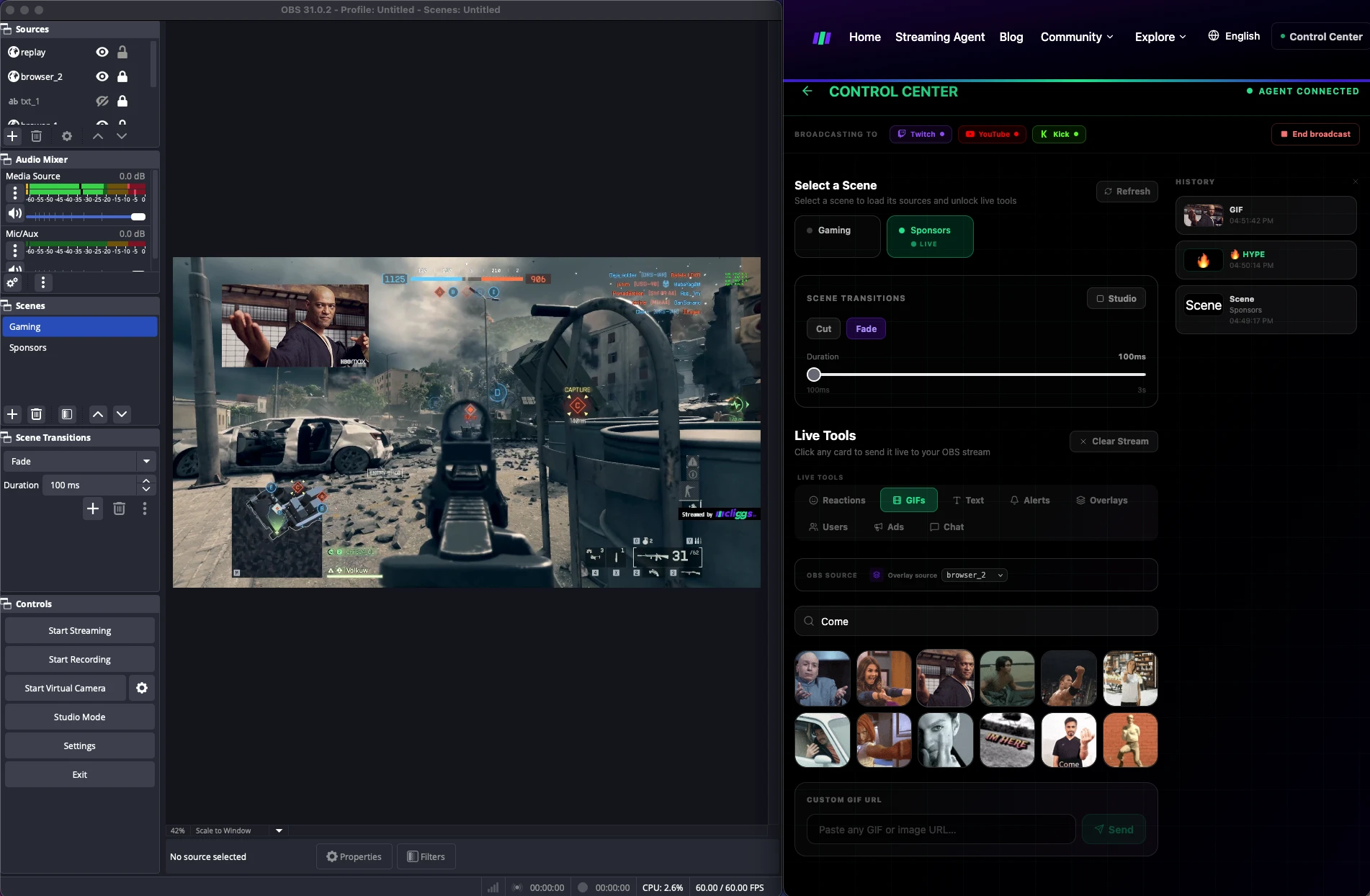
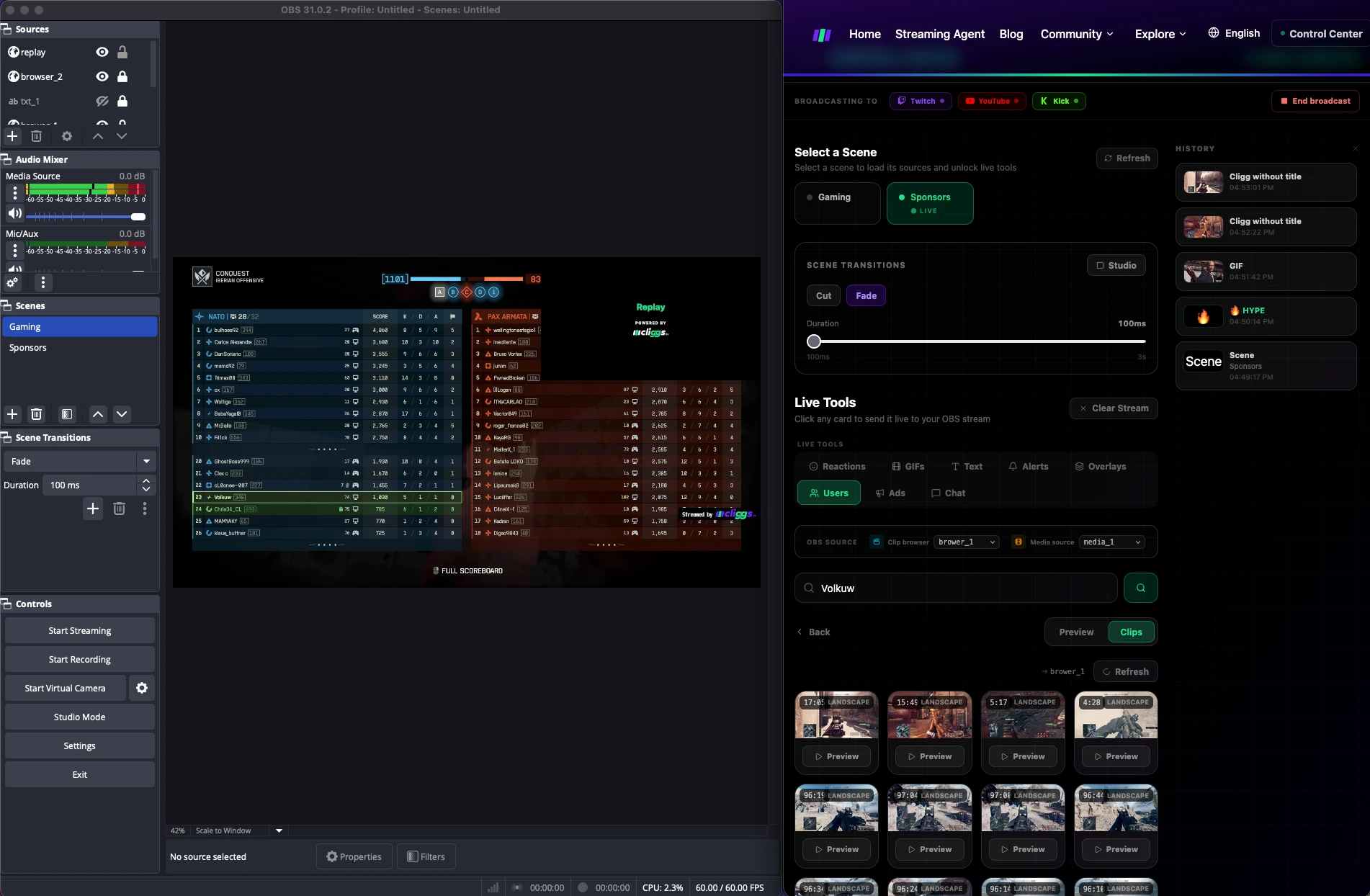
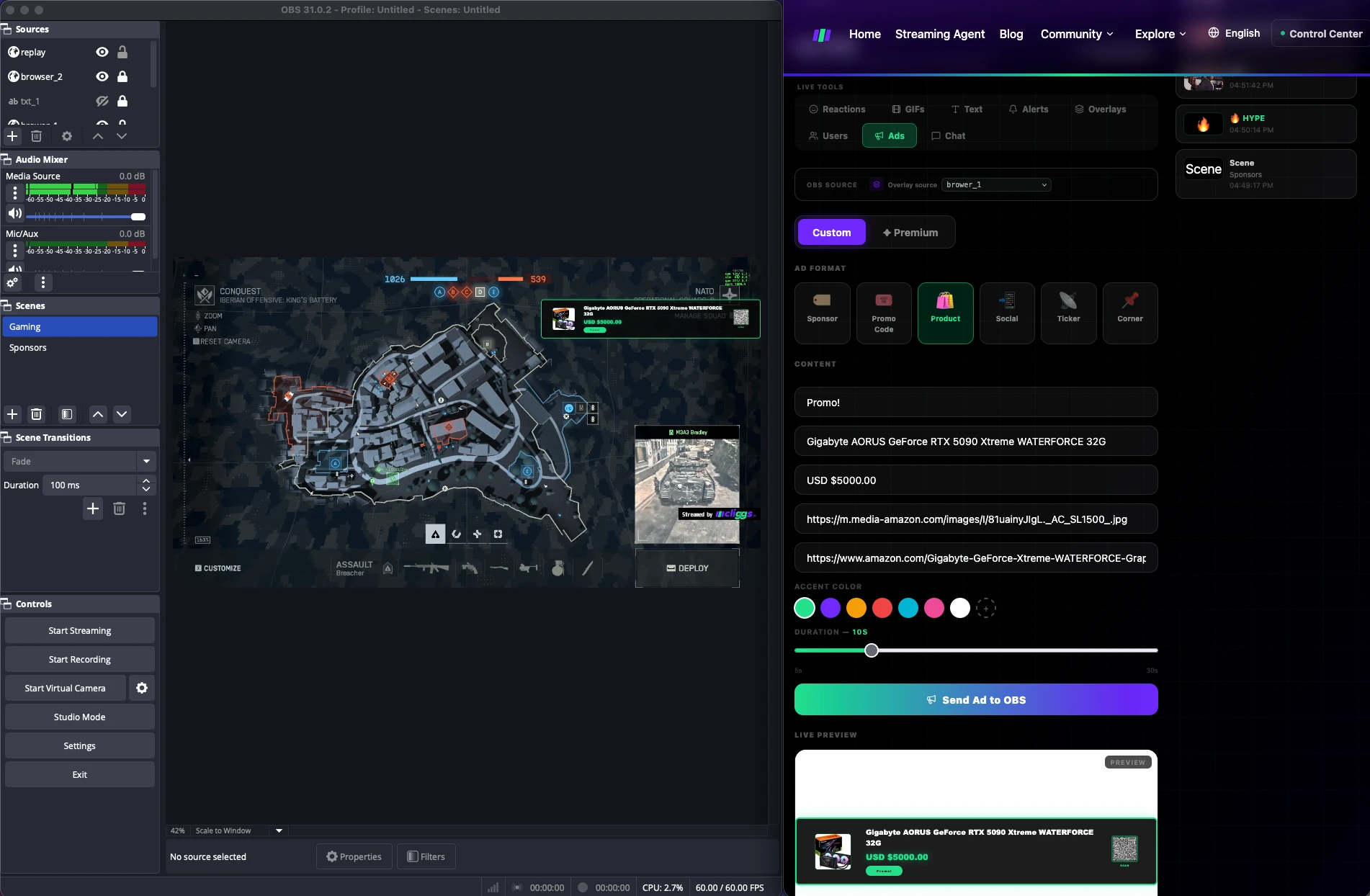
- Keep a history of what you've fired. A History panel on the side logs every action — which scene, which tool, and exactly when — so you can see what just went out without guessing.
The philosophy is the same one running through the rest of Cliggs: Control Center doesn't ask you to replace OBS or rebuild your scenes — it sits on top of what you already have and gives you one surface to run the parts of streaming that used to mean five separate windows. If you've ever fumbled a scene switch or a browser-source alert mid-clutch-moment because it lived in a different app than everything else, this is the fix.
⏺️ Recording happens automatically, in the background
Here's the part streamers tend to appreciate most once they stop thinking about it: Cliggs automatically records your stream the moment you go live. You don't need to remember to hit record, you don't need a separate local recording pipeline, and you don't need to worry about losing footage if OBS crashes mid-session (the encoder and the recording aren't riding on the same fragile assumption that you'll never forget a step).
That recording becomes the raw material for the next stage — and it's also just a safety net on its own. Had a session where chat was incredible but you don't remember exactly what happened at minute 47? It's there. Want to go back after the fact and find a moment you didn't even realize was clip-worthy in the moment? It's there too.
📝 A few practical notes
- You need OBS already installed and configured with your usual scenes/sources — Cliggs doesn't replace your capture setup, it extends it.
- The companion app runs alongside OBS, not instead of it, so your existing plugins, filters, and overlays keep working exactly as they do today.
- Because recording and relaying happen through Cliggs' pipeline once you're live, there's no separate "remember to also record locally" step to forget.
If you've ever lost a stream to a crashed local recording, or skipped streaming to a third platform because setting up a second encoder wasn't worth the hassle, this stage alone tends to be the one that changes people's minds about switching.
3. ✂️ Automatic Clip Suggestions (and Full Manual Control When You Want It)
This is the feature Cliggs is named for, and it's the part that turns "I have hours of footage somewhere" into "here's my best play, published, tagged, and live" in a few clicks instead of a few hours.
🤖 How the suggestion pipeline works, conceptually
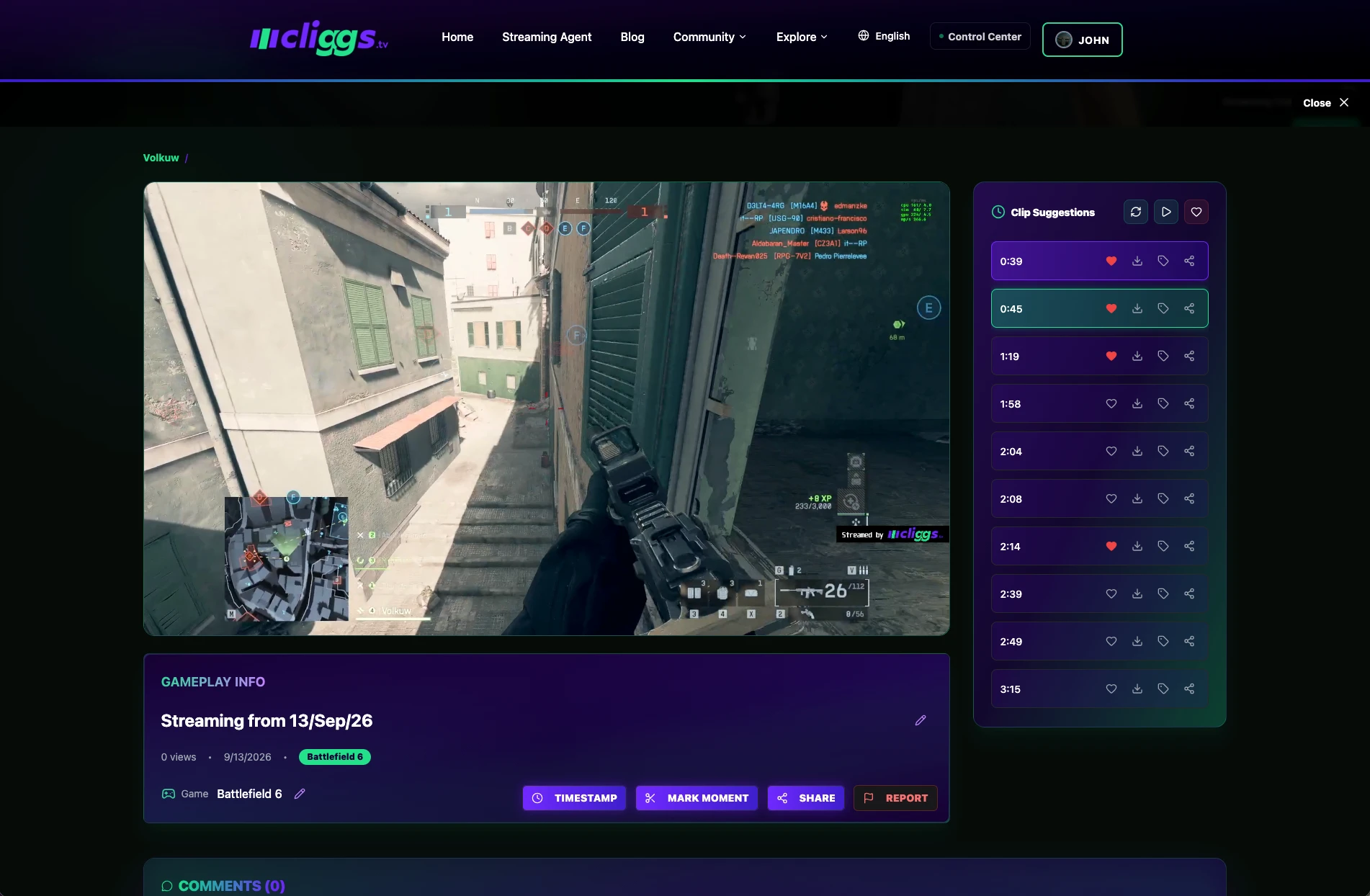
As you play, Cliggs' streaming pipeline watches your session and flags likely highlight moments automatically — almost in real time, not after you've already logged off. Open up any gameplay and you'll see a Clip Suggestions panel sitting right next to the video player: a running list of timestamps (0:39, 0:45, 1:19, and so on) that Cliggs already found for you, each one ready to favorite, download, tag, or share with a single click. By the time your session wraps up, the best parts are already waiting for you instead of hiding somewhere in an hour of raw footage. Other gameplays on your profile even show a "findings" count, so you can see at a glance how many highlight-worthy moments Cliggs already caught before you looked. Support for additional titles is expanding, so exactly which games get automatic detection will keep growing over time.
This matters because the single biggest reason great gameplay never gets shared isn't a lack of great gameplay — it's the tedium of finding it after the fact. Most clips die in a folder because reviewing forty-five minutes of raw footage to find fifteen seconds of magic just isn't worth someone's Tuesday night. Automating that first pass removes the actual bottleneck.
🎯 You're never stuck with what the algorithm picked
Automatic suggestions are a starting point, not a limit. If Cliggs' timeline missed something, or you want a moment it didn't flag, the Mark Moment button sitting right under the video player lets you cut your own clip from any timestamp, on the spot. A Timestamp button lets you jump to and reference exact moments, and full manual control lives right alongside the automated suggestions — you're never boxed into "take it or leave it."
✨ Polishing a clip before it goes out
Once you've got a moment you want to share — suggested or self-cut — Cliggs gives you the basic tools to make it presentable without needing a separate video editor:
- Thumbnails: add or choose a thumbnail so your clip actually gets clicked, instead of relying on an autogenerated frame that might catch you mid-blink.
- Tagging: tag the clip by game and content, so it's discoverable by people searching or browsing for exactly that kind of moment.
- Editing after the fact: you're not locked in once you publish — clips can be edited, and if you delete something by mistake, deleted clips can be restored rather than being gone for good.
🚀 Getting it out into the world
Publishing a clip on Cliggs makes it part of the platform's feed and search — but sharing doesn't have to stop there. Cliggs supports one-click export straight to TikTok, so a highlight that lives natively on Cliggs can also ride the short-form wave without you re-uploading and re-formatting it by hand. You can also download your own clips (or ones you've liked) if you want the raw file for something else entirely — a montage, a highlight reel, a submission somewhere off-platform.
🧹 Keeping the clip pool healthy
Clip platforms live or die by the quality of what's actually watchable in them, so Cliggs includes a straightforward way to report inappropriate clips, keeping the space focused on what it's meant to be: genuinely good gaming content, not spam or abuse.
❤️ Why this stage is the heart of Cliggs
Take the signup speed from stage one and the zero-effort recording from stage two, and this is where they pay off. By the time you sit down to actually look at a session, Cliggs has already done the tedious part. What used to be "maybe I'll go find that clip this weekend" becomes "it's already sitting there, tagged and ready to publish." That shift — from clipping being a chore to clipping being basically free — is the whole premise of the platform.
4. 🌐 A Community Built Around the Game, Not Around You Watching Ads
A clip nobody sees is just a file. The fourth piece of Cliggs is what happens after you hit publish — who finds it, who engages with it, and what it connects you to.
👍 The basics: likes, comments, views
Every clip on Cliggs can be liked, disliked, and commented on, with view counts attached so you can actually see whether something landed. That sounds obvious, but it's the foundation everything else builds on — without a real feedback loop, clipping is a monologue. With one, it's a conversation.
🔍 Getting discovered without needing an existing audience
New creators face the same problem everywhere: nobody sees your content until people already see your content. Cliggs works against that with a few different discovery surfaces:
- A public clip carousel/feed on the platform's front door, so good clips can surface even without a following behind them.
- Trending clips and GIFs, which highlight what's currently landing with the community, not just what's newest.
- A "top creators" ranking, giving standout uploaders visibility beyond their existing follower count.
- Unified search across people, games, events, and clips — plus more targeted search specifically for clips, GIFs, or gaming "moments" — so people looking for a specific kind of content (a specific game, a specific play type) can actually find it instead of scrolling forever.
🪪 Following, profiles, and your own footprint
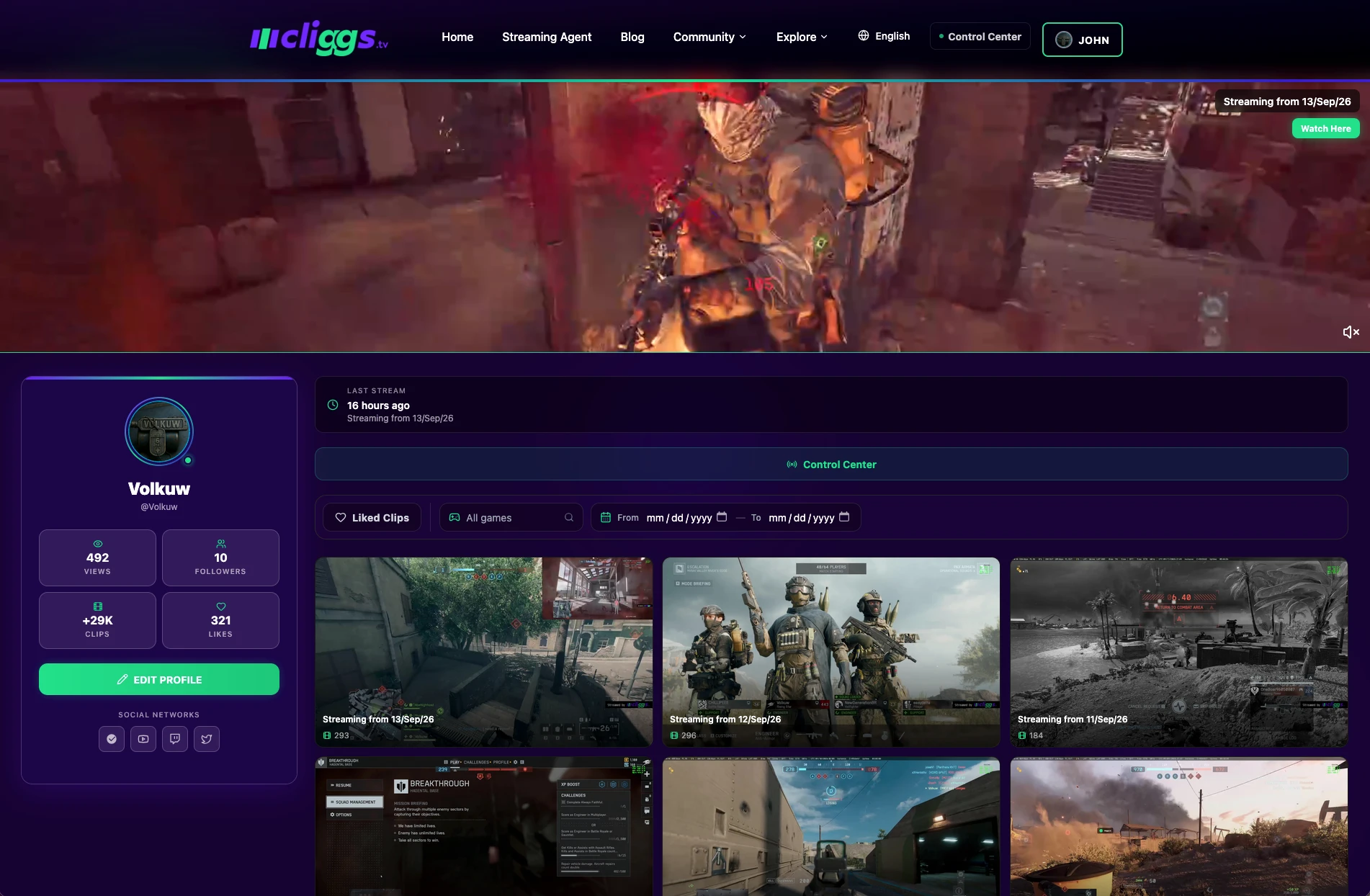
You can follow the players and creators you want to keep up with, and build your own following the same way. Your My Profile page is where all of that lives at a glance: view count, followers, total clips, and likes are right up top, with a full grid of your gameplay clips underneath — filterable by game or by date, with a dedicated Liked Clips view for everything you've favorited from other creators. Your linked social networks sit right there too, and Control Center is one click away if you're jumping straight into a stream. A platform-wide leaderboard/ranking gives a sense of where you stand against everyone else. If you connect your in-game stats, your profile becomes more than a clip archive — it's a snapshot of who you actually are as a player, tied to the plays that prove it.
You can also block users when you need to, because a community feature isn't complete without the ability to control who you actually interact with.
🏆 Teams, tournaments, and events — competing, not just posting
This is where Cliggs goes further than a typical clip site. Instead of stopping at "upload and hope for engagement," the platform has actual competitive structure built in:
- Teams: create or join a team, with team leaderboards and member management, so your gameplay identity can extend beyond a solo profile.
- Gaming events and tournaments: browse events and matches with full detail pages, see brackets and standings, and follow how a tournament unfolds.
- Submitting clips to events: rather than tournaments and clips being separate systems, you can submit clips directly to specific gaming events — your best plays from a tournament run become part of the tournament's own record, not just your personal feed.
- Following your favorite games: browse the games Cliggs supports and follow the ones you care about, so events, clips, and community activity for those titles come to you.
💬 Why community is a feature, not a side effect
A lot of platforms treat "community" as whatever happens to accumulate around content once enough people show up. Cliggs treats it as infrastructure: discovery surfaces that don't require an existing audience, competitive structures that give clips a purpose beyond a like count, and identity tools (profiles, stats, teams) that make your presence on the platform feel like it belongs to you, not just to an algorithm's feed. The result is a place where posting a clip isn't shouting into a void — it's dropping something into a system that's actually built to circulate it to the people who'd care.
5. 🔥 Why Cliggs, and Not Somewhere Else?
By now the shape of the answer should be obvious, but it's worth saying directly: most alternatives make you choose. Stream on one platform. Clip on another app. Edit somewhere else. Share to yet another feed. Hope your community follows you across all four. Every one of those hand-offs is a place where footage gets lost, momentum dies, and the fun part of gaming — showing off the moment that made your session memorable — turns into a chore you keep meaning to get to.
Here's what actually sets Cliggs apart:
🎮 Built for gaming, not retrofitted for it. Generic video and clip platforms have to guess whether your content is "engaging" using signals built for cooking videos and vlogs. Cliggs is gaming-first from the ground up — highlight detection tuned for gameplay moments, tagging by game and title, in-game stat integration, and tournament infrastructure that a general-purpose platform simply doesn't have a reason to build.
🌍 One setup, every platform. Connect OBS once through the companion app, and your stream goes out to Twitch, YouTube, and Facebook simultaneously — without extra encoders, extra local CPU load, or extra effort every time you go live. You stop choosing which audience gets your attention and just... reach all of them.
🕹️ One dashboard for everything mid-stream. Control Center replaces the usual pile of separate tools — a chat client, an alert box, an overlay manager — with a single live dashboard that fires straight into OBS. No plugins, no alt-tabbing, no rebuilding scenes you've already tuned.
✂️ Clips find themselves. Automatic highlight detection means your best moments don't sit buried in raw footage waiting for a free afternoon that never comes. The tedious part — finding the moment — is done before you even sit down to look.
🤝 A community, not just a feed. Teams, leaderboards, tournaments, and events give your clips somewhere to matter beyond an engagement metric. You're not just posting into a scroll — you're part of a structure that's built around competing, following, and belonging to something.
🪪 One identity across everywhere you already are. Sign in with the accounts you already use, link them together, and let your Cliggs profile become the hub that ties your Discord, Twitch, TikTok, and gaming stats into one coherent presence — instead of five disconnected footprints of the same person.
🎯 The whole point
Play. Stream. Clip. Share. Compete. On most setups, that's five separate tools, five separate logins, and five separate places for momentum to die. On Cliggs, it's one loop — designed from sign-up onward to get out of your way and let the gameplay do the talking.
Whether you're a viewer looking for gaming highlights that are actually good, or a streamer tired of juggling a recorder, an editor, a multistream tool, and an upload checklist for every platform, Cliggs was built to make the whole thing feel like one thing instead of five.
Right now, somewhere in your last week of gameplay, there's a moment worth showing people — and it's either sitting in Cliggs' Clip Suggestions waiting for you, or it's buried in a folder you'll never open again. Signing up takes less time than reading this post did. Sign up on Cliggs and let's find out what you've been sitting on.